 by
by Citadel bought Leopold's book: what 4x leverage cost
A 24-year-old ran an AI fund to roughly $45 billion and +439% net through June. Three weeks later his prime brokers called margin and Ken Griffin's Citadel bought the entire public book in one block. The thesis was not the thing that broke.
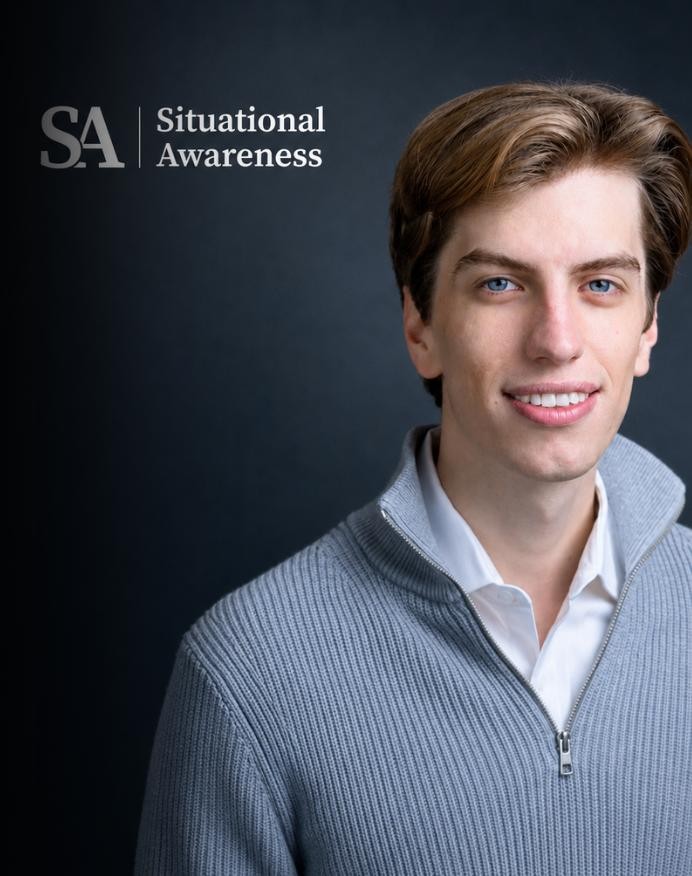
- Situational Awareness peaked near $45B in early July, was around $24B after the AI equity rout, and sits near $10B after selling its public book to Citadel (Bloomberg, CNBC).
- The book ran roughly 4x leverage. At 4x, a 35% fall in the assets costs 140% of the equity — the margin call is arithmetic, not bad luck.
- Goldman Sachs, JPMorgan and Bank of America — all three prime brokers — called at once. There is no orderly exit when the same names are in everyone's book.
- Seven tickers, one exposure: compute, memory and power for AI, including two former bitcoin miners. Crypto-adjacent equity did not diversify the AI trade; it concentrated it.
- The desk call: the miner-to-AI names now trade with a known price-insensitive holder and no forced seller. That changes the flow, not the fundamentals — treat them as one position.
The chain of the argument
@LeopoldTracker_, an account that follows the fund's disclosures, laid out a three-day sequence and asked whether Citadel had rug-pulled a forced seller: a rate call on the 28th, a selloff and a margin call on the 29th, the block trade on the 30th — and then the same names up 15% to 29% the same day.
Goshawk Trades answered the conspiracy reading with a construction one, quoting Ken Griffin on why portfolio managers wash out at Citadel: an extraordinarily concentrated book, large positions, no concise account of the edge. Griffin's answer for why Citadel survives was experience — "the price paid in losses and pain that converts into wisdom." Situational Awareness started in 2024. There was no bitter lesson priced into that book yet.
@TheFlowHorse pointed at TBPN's full interview with Martin Shkreli, which walks through the same mechanics from the other side: why 4x could not be unwound quietly, which firms were tapped to buy, and why a fund cannot simply hit sell on a position that size.
He wasn't wrong about AI. He was wrong about the construction of his book.
The two readings
It was opportunism
the rug-pull reading
Citadel published a rate call that historically tanks the market on the 28th, bought the book on the 30th, and the same names rallied 15–29% that day. The sequence is the argument.
@LeopoldTracker_Rate hike coming, whole market dumps, the fund gets margin called — then no hike, and the firm that made the call owns the book. You cannot make this up.
@PerpetualmaniacAn engineered rug pull: liquidate the seller, then buy his positions cheap.
@TribeRuffnerHe wrote the definitive paper on AI taking over everything, and got taken over by a market maker instead.
@QuintinMyburgIt was construction
the boring reading
Griffin described this failure mode two years ago: highly concentrated book, large positions, no clear account of the edge. The buyer did not need a plan; the seller needed a different book.
@GoshawkTradesLiquidated one day, everything he was forced to sell rips the next. The market is ruthless — that is the mechanism, not a plot.
@AutismCapitalAt 4x with both legs correlated, the unwind is mechanical. A firm that size cannot exit quietly, which is exactly why the block goes to whoever can hold it.
@TheFlowHorse / TBPNThe bounce is not a windfall either: those names are still down more than 20% on the month. Buying a forced seller's book is buying a drawdown, not a gift.
@ThinkAppraiserThe book
| ticker | company | entry | role in the thesis |
|---|---|---|---|
| $SNDK | SanDisk | 11.2025 · ~$254 | memory for inference |
| $NBIS | Nebius | 05.2026 · ~$198 | AI cloud · 12.4M shares |
| $BE | Bloom Energy | Q4 2025 · ~$111 | on-site power |
| $IREN | IREN | 05.2025 · ~$8 | miner turned AI cloud |
| $CRWV | CoreWeave | — | AI cloud |
| $SKHY | SK Hynix | 07.2026 · IPO | HBM for Nvidia |
| $CLSK | CleanSpark | — | miner turned data centre |
Why this is an investment question
Because the book was not exotic. Compute, memory, on-site power, and two bitcoin miners that turned into AI landlords — the same trade most crypto-native funds have been running in smaller size all year. The names that were supposed to be the crypto leg of an AI portfolio fell with the AI leg, on the same days, for the same reason.
Because the failure was not the thesis. AI infrastructure demand did not disprove itself in three weeks; the Philadelphia Semiconductor Index fell 28.6% from its June peak and the Morgan Stanley Momentum TMT index halved. A book at 4x cannot survive a normal drawdown in a crowded trade, and a book at 1x survives it without a phone call.
Because the flow changed hands. The single largest holder of that basket is now a market maker with no redemption pressure and no thesis to defend. The forced seller is gone; so is the buyer who was mechanically adding on every dip.
Who is right
On the facts, the conspiracy side is describing a real sequence and drawing the wrong arrow between its parts. Citadel publishes rate views constantly; the fund was already down 35% on the month before the 29th; and the buyer of a forced block does not need to cause the forced sale to profit from it. Nothing in the public record shows a plan, and the plainest reading of a firm buying $10B+ of AI infrastructure at a discount is that it wanted $10B+ of AI infrastructure at a discount.
On the mechanics, the construction side is right and slightly smug about it. A book at 4x with correlated legs is a position that decides for you when it exits. Nobody had to engineer the volatility — the AI complex fell hard enough on its own, and the leverage did the rest.
The part both sides get wrong is the rebound. A 15–29% bounce the day after a forced sale is what a liquidity vacuum looks like when the seller stops selling. It is not proof of theft and not proof of skill; those names are still down more than 20% on the month, and whoever holds them holds a drawdown.
Right on the mechanism: the construction side. Right on the discomfort: the conspiracy side. A market where one firm is the only viable buyer of a $10B block is not rigged — it is thin, and thin is worse, because it shows up in your book too.
What he said himself
The thesis the fund was built on he laid out publicly back in 2024: if models get good enough to do the work of an AI researcher around 2027, the system starts improving itself and everything bottlenecks on compute, memory and power. That, not any particular ticker, is what the portfolio Citadel bought was expressing.

The Dwarkesh interview, June 2024 — the thesis the fund was built on
Two weeks before the margin call he was talking about the biggest investment opportunities of 2026–2030. Nothing in July disproved those clips: what was liquidated was not the thesis but the structure carrying it.
The TT desk thoughts
We hold the miner-to-AI complex as one exposure, not four. IREN, CleanSpark, Core Scientific and Hut 8 stopped being a bitcoin position when their revenue moved to AI leases; they now correlate with Nebius and SanDisk, not with bitcoin. Sizing them as separate lines is how a book ends up 4x concentrated while its spreadsheet says diversified.
The practical rule we run on our own book: leverage is capped at 1.0 and long and short are never open at once, which is why our published strategies sit in cash for whole years rather than borrow through them. That is not caution as a personality trait — it is the only construction where a 35% drawdown in the names you own is survivable without a counterparty deciding your exit for you.
What we would act on: not the rebound. The 15–29% bounce the day after the block is the least repeatable part of this story. What is repeatable is the setup that produced it — a crowded book, one direction, borrowed money, and instruments liquid enough to be taken away from you. Check your own book for the first three; the fourth is the only mercy in the list.
How to protect your own portfolio
Count exposures, not tickers. Group positions by what would have to be true for them to fall together. Seven names that all need AI capex to keep rising are one position. Our own limit: no exposure group above 20% of the book.
Assume no leverage until you can name the lender's rule. If you cannot state the exact drawdown at which someone else can close your position, you do not have leverage — leverage has you. The desk runs at 1.0 for this reason.
Size to the drawdown, not the thesis. Take the worst peak-to-trough move these names made in the last five years, double it, and check the book still functions. The AI complex just did −35% in three weeks; the last cycle did worse.
Keep an exit that does not depend on a counterparty. A position that takes a week to sell is a position someone else may sell for you. Liquidity is a property of your size relative to the venue, not of the name.
Write the invalidation before the entry. One line: what has to happen for this to be wrong, and what you do that day. A fund with that line does not need three prime brokers to define it at 4am.
What Leopold should do now
Keep the private book and stop being a public-equity fund. The Anthropic stake — roughly $5B — survived precisely because nobody could margin-call it. That is the business he is actually good at: early, illiquid, thesis-length positions in AI, held through noise.
Publish the post-mortem before someone else writes it. He built an audience on a 165-page essay about what he could see that others could not; the honest version of what he could not see is worth more to that audience than a quiet rebuild.
If he raises again, raise capital that cannot run. Lock-ups, no prime-broker leverage, and a mandate that says concentration out loud — investors who want a 4x AI bet should sign for a 4x AI bet, not discover it in a margin call.
The thesis is not the thing to change. AI infrastructure demand did not disprove itself in three weeks. What has to change is that a correct thesis on a leveraged book is still a loss, and a correct thesis on a survivable book is a business.
What would change our mind
Evidence that the AI-infrastructure names can absorb a leveraged unwind without a single buyer of last resort — a second forced seller this size clearing into the open market at prices close to the last print. Until then, we read the depth in these names as smaller than their volume suggests.
Keep reading
Crypto Capital Flows Analysis — the full framework · The playbook — entries, exits, and when to stand down · All alpha