+First time on the top traders desk?
The desk runs its own numbers and publishes its calls next to the account that trades them. The short route:
 by Top team
DeBank alternatives: 7 wallet trackers compared
There is no single best DeBank alternative: there are three different jobs, and the right tool depends on which one you're doing. DeBank is a portfolio reader. If you want to name a wallet you need Arkham. If you want labeled cohorts you want Nansen or a Dune dashboard. Below is the honest breakdown (chains, free tier, whale labeling and best-for) with no tool being sold to you.
- DeBank's edge is a clean, free, very-wide multichain DeFi portfolio view, not identity.
- Arkham is the strongest free alternative for whale identity (entity attribution).
- Nansen owns labeled Smart Money cohorts, but the depth is paid.
- Zerion and Zapper are the closest like-for-like free portfolio swaps for DeBank.
- Free block explorers are the ground truth every other tool is built on top of.
- Dune dashboards give you free, custom whale leaderboards no single app ships.
- Most desks run three tools, not one: a portfolio reader + an identity tool + an explorer.
The comparison table
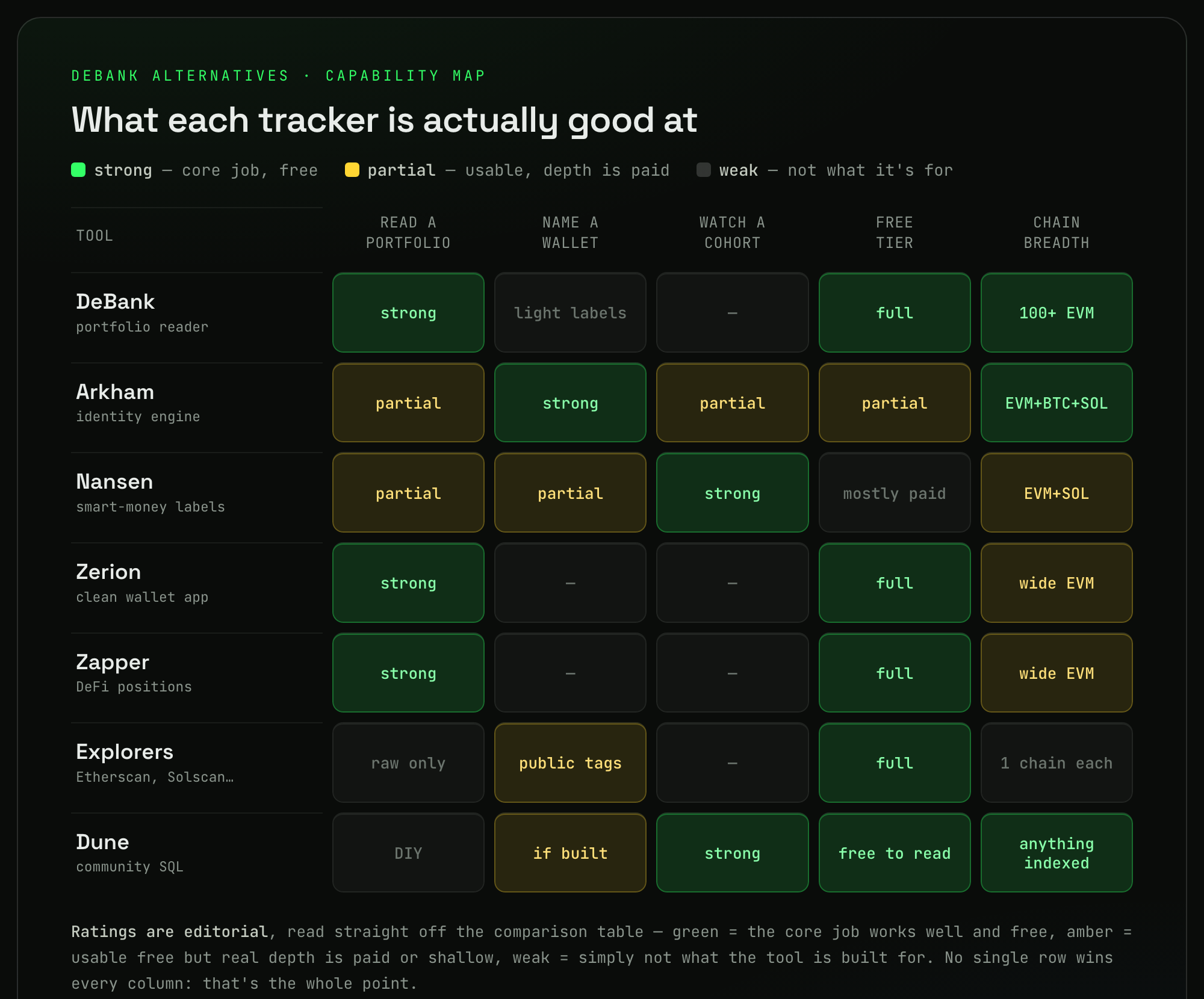
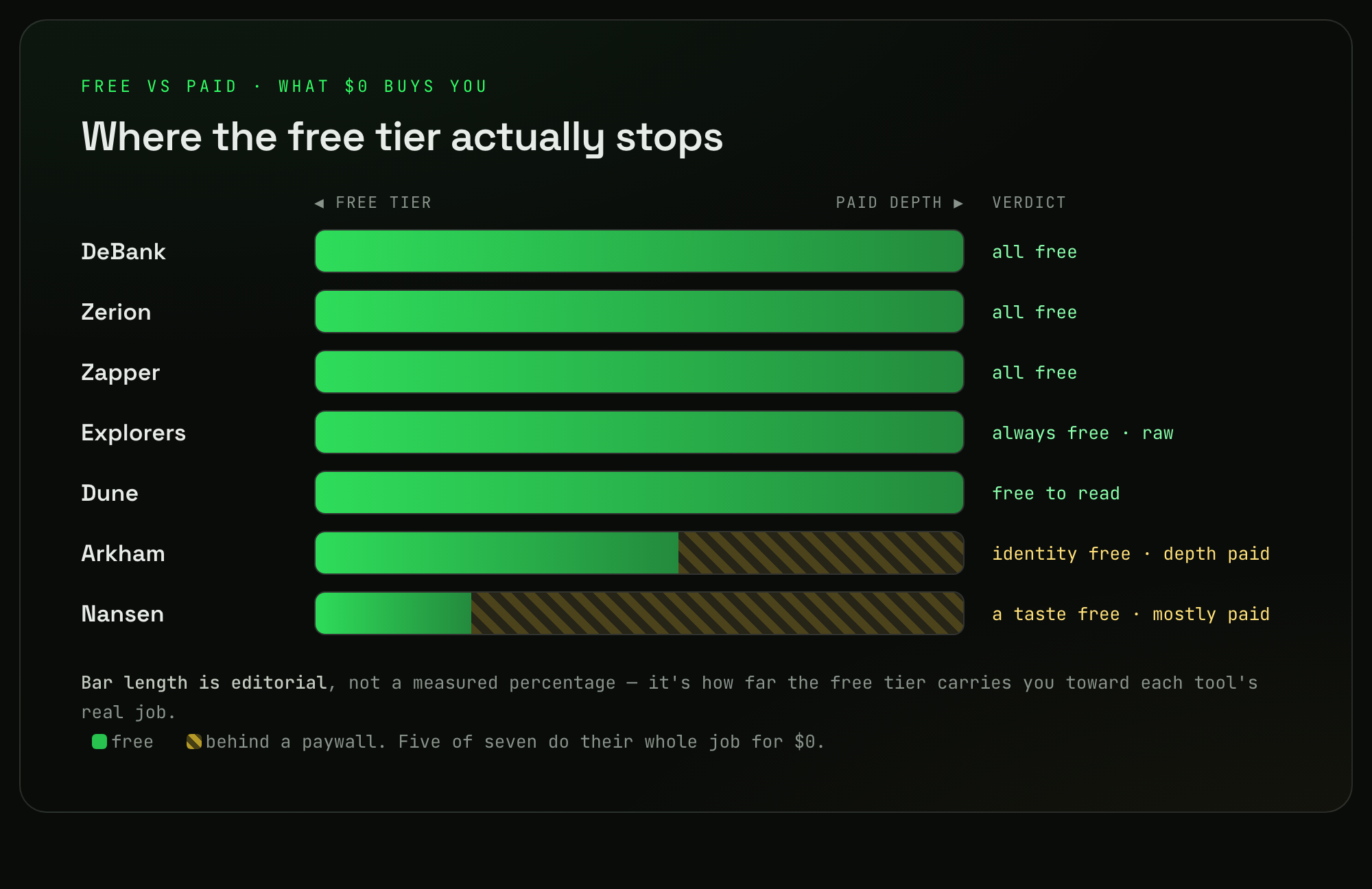
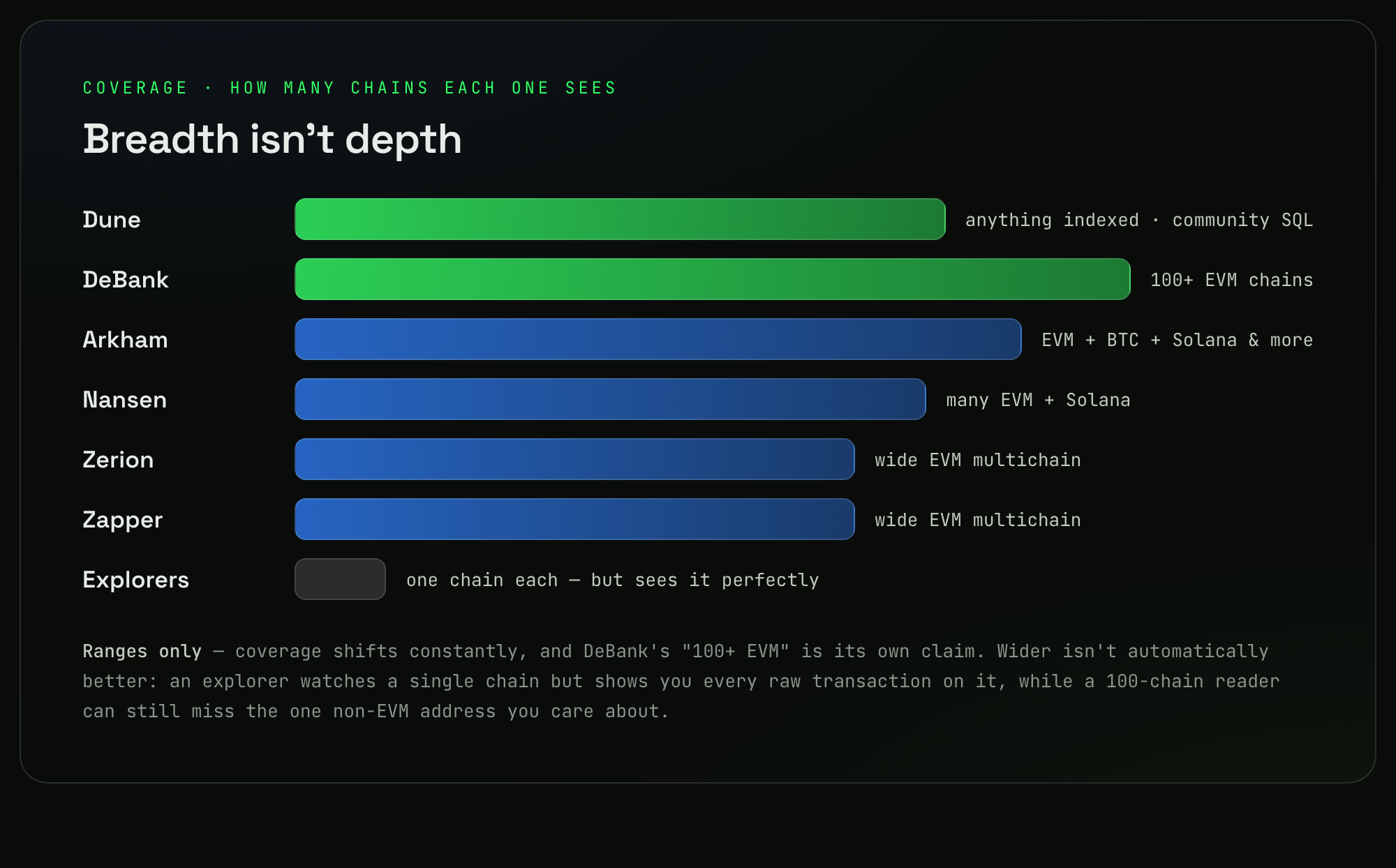
Free-tier column: Full = the core job works free, Partial = usable free but real depth is paid. General ranges only: exact chain counts and tier limits shift, so verify current specifics on each tool before you commit.
| Tool | Chains covered | Free tier | Whale / labeling | Best for |
|---|---|---|---|---|
| DeBank | Very wide EVM (100+ EVM chains) | Full | Portfolio-first; follows any address, light labels, Web3 social layer | Reading any address's full DeFi portfolio across EVM chains at a glance |
| Arkham | Multichain: EVM + BTC, Solana & more | Partial | Strongest entity attribution — maps addresses to named funds, exchanges, people | Putting a name to an address; exchange & fund attribution |
| Nansen | Many EVM + Solana & others | Partial | Best labeled cohorts — “Smart Money” wallets and flow dashboards (paid depth) | Watching a labeled cohort move as a group — if you pay |
| Zerion | Wide EVM multichain | Full | Portfolio-first, light labeling, clean alerts | Clean wallet UX and tracking a handful of addresses free |
| Zapper | Wide EVM multichain | Full | DeFi positions + address bundling, light labels | DeFi position tracking and bundling several wallets into one view |
| Free explorers (Etherscan, Solscan…) | One chain each | Full | Public labels (exchange/contract tags), top-holder lists, raw txns — ground truth | Verification, holder lists, following raw transactions |
| Dune dashboards | Anything indexed (community SQL) | Full | Whatever a dashboard builds — whale leaderboards, cohort flows | Custom whale leaderboards and cohort analytics, free to read |
How to read the table — the three jobs
Job one: read a portfolio. You have an address and want to see everything it holds. DeBank, Zerion and Zapper all do this free and well. DeBank has the widest EVM coverage and the cleanest single-view; Zerion has the nicest app; Zapper is strongest for messy DeFi positions and bundling wallets. Pick on feel; they're substitutes.
Job two: name the wallet. A portfolio view tells you what a wallet holds, not who it is. That's Arkham's whole reason to exist: entity attribution that maps a raw address to a fund, an exchange, or a known player, much of it usable on the free tier. For whale work specifically, this is the biggest thing DeBank doesn't do.
Job three: watch the crowd. Sometimes you don't have an address; you want to know what a cohort is doing. Nansen's Smart Money labels are the premium answer (and mostly paid); free Dune dashboards are the scrappy one, giving you whale leaderboards and cohort flows a general app never ships. Start with the free layer and only pay when a specific label is worth it.
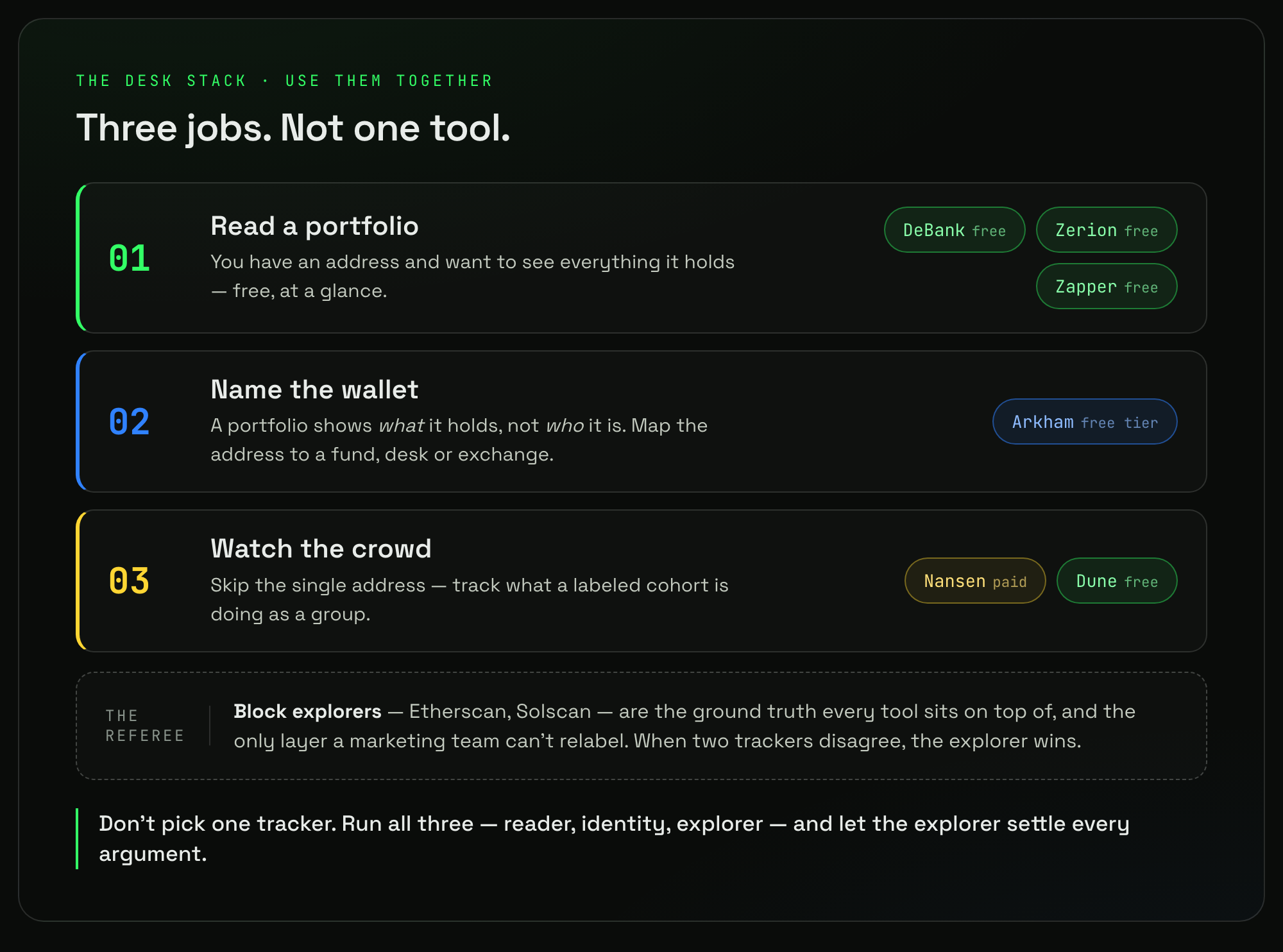
Don't pick one tracker. Run a portfolio reader, an identity tool and an explorer, and let the explorer settle every argument.
Where DeBank still wins — and where it doesn't
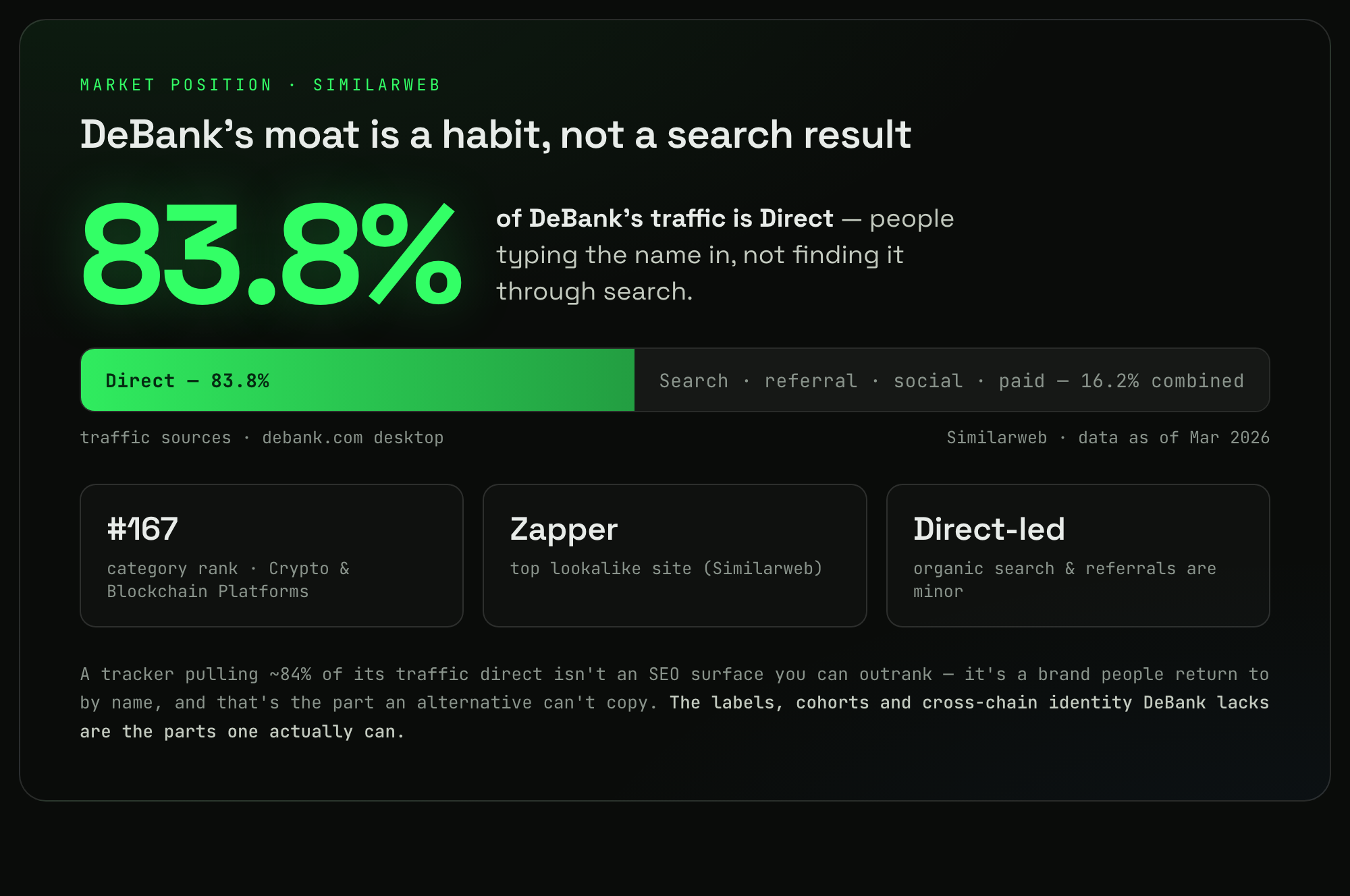
Being honest about the incumbent: DeBank's free, extremely-wide EVM portfolio view is genuinely hard to beat, and its social layer is a real product nobody here fully replaces. What it doesn't do is entity attribution or labeled cohorts, and that's precisely the gap Arkham and Nansen fill. The takeaway isn't “replace DeBank.” It's “DeBank plus one identity tool plus an explorer”, which is what most desks actually run. If you're new to this, start with the workflow in how to track crypto whale wallets before you pay for anything.
Four ready stacks
The table says what each tool is good at. This says what to actually open, depending on which of those jobs is yours. Every stack below is a workflow, not a ranking: the free one is not a worse version of the professional one, it is the right answer for a different job.
Read any portfolio, then verify one transaction by hand on Etherscan. Costs nothing and covers the majority of what a retail reader ever needs. Its limit: you will see what a wallet holds and never who it is.
Add the missing half: a name behind the address. Zerion for the daily read because the app is the least hostile, Arkham when a wallet starts mattering enough to identify. Its limit: attribution is a claim, and it can be stale or wrong.
Entity attribution, cohort labels and custom queries: the combination you need when you are watching a crowd rather than an address. Mostly paid. Its limit: labels are somebody's model of who a wallet is, priced as if they were facts.
The layer under all of the above. When two trackers disagree, or a balance looks impossible, the chain is the referee: read the transfer, check the contract address, and believe that instead. Slow, free, and always right.
The workflow, not the winner. Start free, add attribution when a wallet earns it, pay for cohort labels only when a specific label is worth the subscription, and verify on-chain whenever a number is going to inform a decision. Which tool "wins" depends entirely on which of those four steps you are standing on.
FAQ
The TT desk thoughts
Tool comparisons get gamed because every one of these products has an affiliate program and a marketing budget, so most “best DeBank alternative” lists are just whoever paid. Here's the unsold version: the tool doesn't give you edge; the read does. A tracker is only as good as your ability to strip out the exchange wallets, ignore the wash clusters, and tell a hedge from a conviction buy. The desk uses all of these and trusts none of them blindly; the block explorer is the referee, because it's the only layer that can't be relabeled by a marketing team. Get comfortable moving between a portfolio view, an identity check and the raw chain, then go learn to read the whole portfolio like a desk. That's the part no subscription sells you.
What would change our mind
A tracker that publishes scored calls rather than data, and beats the desk read over a sample. The argument is that tooling is table stakes and interpretation is the edge; a tool that demonstrably supplies the interpretation would overturn it.
Keep reading
How to track crypto whale wallets (free tools) · How to read a whale portfolio like a desk · Crypto Capital Flows Analysis · All alpha