+First time on the top traders desk?
The desk runs its own numbers and publishes its calls next to the account that trades them. The short route:
 by Sarah Connor
Token vs equity: the Venice $VVV debate, for and against
A sharp exchange this week cut to one of the most important questions in crypto investing: in a company with both private equity and a public token, does the token actually own anything, or is it retail exit liquidity dressed up as a use-case?
- The debate: in a company with both private equity and a public token, does the token own anything, or is it retail exit liquidity? Rob Hadick framed Venice's $VVV as a hedge on future compute prices; VIKTOR countered that nobody bought it for that.
- Fiskantes' structural point: a dual equity/token structure carries a built-in incentive to route value away from the token toward the equity insiders hold.
- Venice's discretionary buy-and-burn jumped to ~20k/day from 6-8k, tying $VVV to compute sales, but critics note holders have no contractual claim, only a promise the company won't change the terms.
- Felipe Montealegre's 'Tokens are Broken': lemon-market asymmetry cuts token valuations ~78-80% versus equity (a P/E of 22 collapsing to ~5), and even Uniswap Labs earns ~$90M/yr in front-end fees while UNI accrues zero.
- The TT desk call: favor projects where the token is the only instrument of ownership (Hyperliquid, Lighter) over projects where it is a sidecar to a closed cap table: where it's an add-on, assume it's the exit, not the asset.
The chain of the argument
Rob Hadick (Dragonfly) framed Venice's token, $VVV, as a way to hedge future compute prices. VIKTOR (@thedefivillain) pushed back: argue about phrasing all you want, but the token supposedly hedges compute, and literally nobody bought it for that. Hadick said that wasn't what he claimed. Fiskantes (Zee Prime) quoted VIKTOR and sharpened it: a dual equity/token structure carries a built-in incentive to distort where value accrues. Then Haseeb (Dragonfly) posted a video defense, and the replies split hard.
The token supposedly hedges compute, but literally nobody bought it for that reason.
The two sides
For — the token has a real role
Dragonfly & supporters
The token is a way to hedge future compute prices; VVV is bought and burned so more compute can be sold for cash, a real demand loop.
@hosseeb / DragonflyTwo entities, different use-cases, both needed for Venice to scale. Equity and token don't conflict: holding either is fine.
@fairdotclubDiscretionary burns jumped to ~20k/day from 6-8k. The buy-and-burn ties the token to actual compute sales.
@ThewastedyeaEven critics concede VVV genuinely helped bootstrap the product in the first place.
@burstingbagelAgainst — the token is exit liquidity
VIKTOR, Fiskantes & the crowd
Equity gives legal rights to company profits. VVV gives none: it rests on a promise the company won't change the token's terms later.
@thefrankbraunA dual equity/token structure has a built-in incentive to route value away from the token toward the equity insiders hold.
@fiskantesIs VVV's utility really worth $1B, equal to the equity controlling revenue? What stops insiders halting buybacks or stripping the utility?
@ChainLinkGodGet the price up, dump tokens on retail, recover the investment, and keep the equity share of Venice untouched.
@BecauseYrBoredThere's no contractual agreement between the lab and holders: like Strategy can stop paying $STRC yield, Venice can change the deal.
@SirMoremoneyThe exchange, in their words
Why this is an investment question, not drama
Strip away the personalities and the core is structural: can a token inside a dual equity/token structure be anything more than exit liquidity for retail? When ownership is split, incentives route economics to whichever instrument the insiders hold, and that is the closed equity, not the public token. Absent a legal claim, the token holds only a promise.
The TT desk thoughts
One more argument for a simple portfolio filter: favor projects where the token is the only instrument of ownership (Hyperliquid, Lighter) over projects where the token is an add-on to a closed cap table. Where the token is the whole business, value accrual and incentives point the same way. Where it's a sidecar to private equity, assume the token is the exit, not the asset.
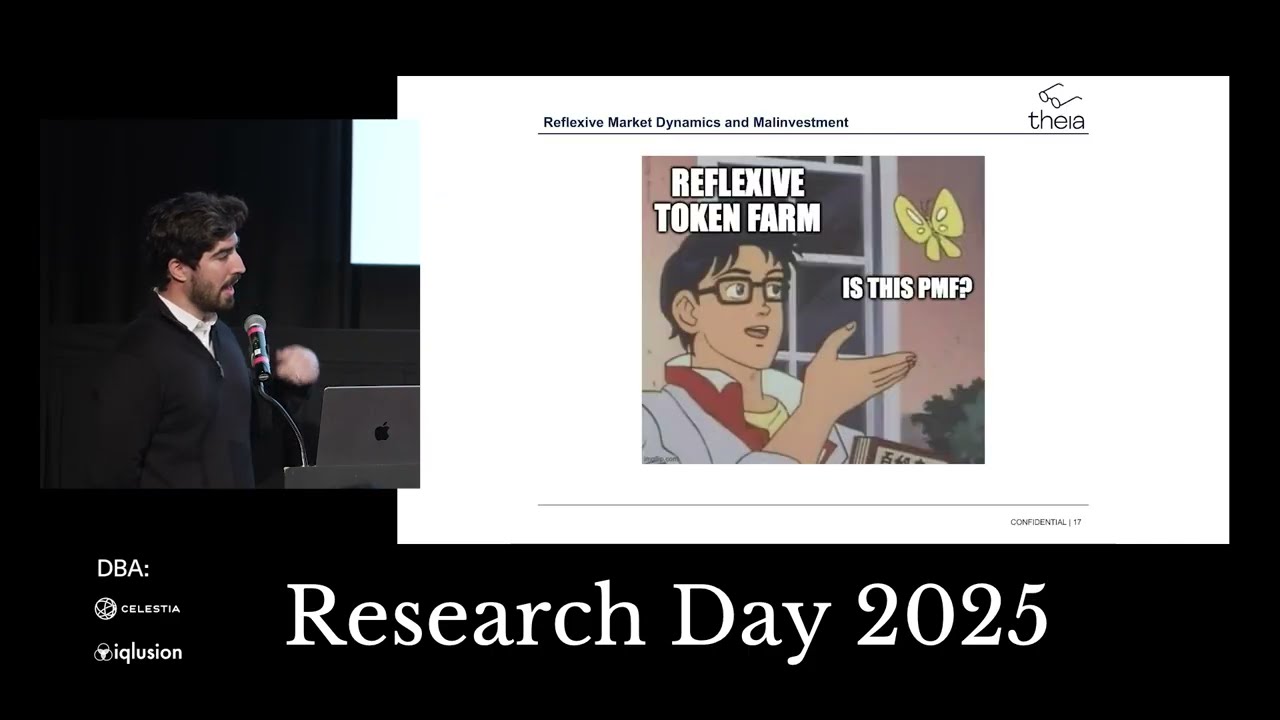
A clear-eyed look at how tokens actually work today
▸ Summary video: "Tokens are Broken"
A comprehensive summary of the presentation by Felipe Montealegre (Theia Research).
1. Two core themes: lemon markets & malinvestment
- The "lemon market" risk. Drawing on George Akerlof's 1970s used-car theory, token markets suffer severe asymmetric information. Buyers can't tell "peaches" from "lemons" (hidden market-maker deals, insider selling, no standard disclosures), so the market prices all tokens as lemons. Good founders leave: an adverse-selection loop that cuts token valuations ~78-80% vs equity (a P/E of 22 collapses to ~5).
- Malinvestment. Capital should flow via a healthy loop between allocators and paying customers. In crypto that loop is broken: the incentive becomes pumping a token long enough to show artificial TVPI (raise a new fund) or exit: "narrative Stalinism," where whoever controls the hype controls the capital, detached from reality.
2. The broken paradigm across participants
Project teams
- CEOs spend 50%+ of their time managing token markets instead of building the business and finding PMF.
- Morale swings with macro; engineers want to quit when the token drops 50%, volatility early-stage startups shouldn't face.
- Teams over-engineer five-page tokenomics (moving cash pocket to pocket) instead of iterating on the core product.
Venture capitalists
- Low float / high FDV launches block liquid funds from bidding → "death by a thousand unlocks," a down-only chart.
- Points programs create an illusion of PMF; artificial TVL/volume vanishes after TGE, burning months of morale.
- The pool of unsophisticated retail is "milked and depleted": like online poker after the fish leave, pros trade each other and the structure falls apart.
Liquid funds
- No legal protections. Unlike public markets, token investors face "adverse maneuvers": slow rugs, routing revenue offshore, million-dollar "advisory fees" draining holders.
- Value dilution & parasitic equity. Teams launch a "second token" for a new line, or route fees to the equity entity. Even Uniswap Labs earns ~$90M/yr in front-end fees while UNI accrues zero from those app fees.
3. Potential frameworks & solutions
- Token stoicism. A public-CEO mindset (Bezos: don't feel 30% smarter when the stock's up 30%). Only launch a token after clear PMF.
- Simpler capital structures. Resemble proven equity (streaming dividends, share classes); TGE at lower, sustainable caps liquid books can hold.
- Credible triggering & transparency. Like car-history audits fixed the used-car market, crypto needs a standardized Token Transparency Framework (team holdings, source, related-party txns, OTC sales). Via "Spence's frogs," if rank-10 projects voluntarily disclose, silence looks worse and everyone must follow.
- Futarchy. Conditional prediction markets vote on corporate actions (second token, fee switch); the team executes whichever path prices higher, hardcoding fiduciary duty into the token.
The bottom line
"The token is not the product. The product is the product."
Trading, narratives and triggers make short-term profit, but an industry only sustains value through organic revenue and a real customer base. For an up-only trajectory that survives regulation and decay, the customer must become the ultimate exit liquidity, paying in because the utility justifies the cost.
What would change our mind
A dual-structure project where the token is observed capturing value alongside the equity, through an enforceable claim rather than a promise. The filter exists because that has not happened; one clean case would make it a preference rather than a rule.
Keep reading
Crypto Capital Flows Analysis — the full framework · All alpha