+First time on the top traders desk?
The desk runs its own numbers and publishes its calls next to the account that trades them. The short route:
 by Top team
Fast trend following died in 2009 — crypto never got the memo
A new paper from Jean-Philippe Bouchaud's CFM team puts a date and a mechanism on something CTAs have felt for a decade: short-term trend following stopped working around 2009, and the killer was not crowding: it was high-frequency market making. Meanwhile the freshest evidence says trend still works in crypto, the one big market where that microstructure shift never fully arrived. That gap is the trade.
- A new CFM paper (Kurth, Eisler, Rej, Bouchaud; arXiv, July 2026) tests trend triggers across ~100 liquid futures from 1995-2025 and finds fast trend-following stopped making money around 2009 and never came back.
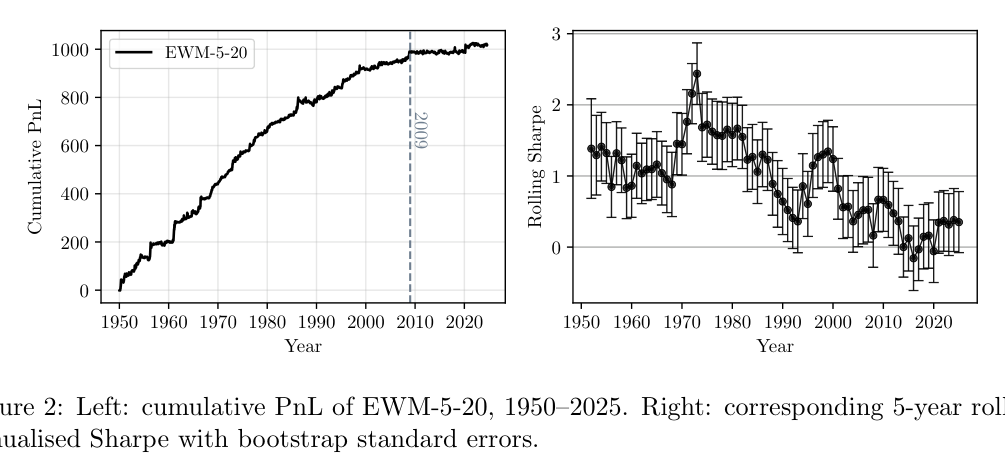
- A CTA-proxy portfolio's rolling five-year Sharpe collapsed from a historical 1-2.5 to statistically indistinguishable from zero after 2010; the fastest 5/20-day trigger fell from 0.84 to 0.12 while the slow 50/200-day held roughly half its edge (0.70 to 0.40).
- The mechanism is not crowding or capacity but high-frequency market making: trend PnL collapsed on small-tick contracts where HFTs dominate and stayed intact on large-tick ones.
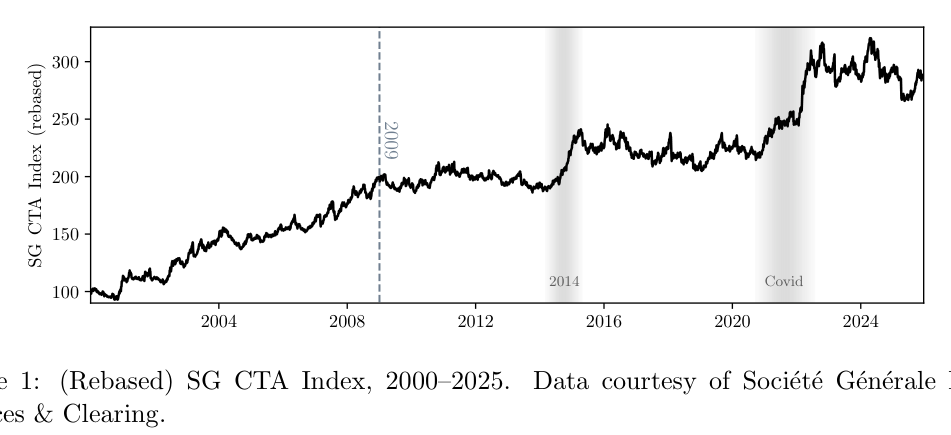
- The pain is live: the SG Trend Index posted -18.6% for the twelve months to May 2025, its worst rolling year in 25+ years, before trend funds bounced ~+8.4% year-to-date by mid-July 2026.
- The crypto exception: research (Zarattini/Pagani/Barbon 2025, Man AHL, Grayscale) finds trend still pays in crypto, the one large market where the HFT small-tick microstructure never fully arrived.
- The TT desk call: run trend slow in traditional assets, faster in crypto, and treat crypto's microstructure maturation as the clock: fast crypto trend dies the day its market making consolidates into a CME-style HFT monoculture.
What the paper actually shows
“Is Trend Still Your Friend? A Microstructural Account of the Demise of Short-Term Trend-Following” (Kurth, Eisler, Rej, Bouchaud; arXiv, July 2026) runs trend triggers across roughly 100 liquid futures from 1995 to 2025. The result is unusually clean for empirical finance: fast trend triggers stopped making money around 2009 and never came back. Cumulative PnL on short-horizon crossovers is essentially flat from 2009 onward, and a CTA-proxy portfolio's rolling five-year Sharpe collapses from a historical 1-2.5 to statistically indistinguishable from zero after 2010.
| Trigger speed (EWM crossover) | Sharpe pre-2009 | Sharpe post-2008 |
|---|---|---|
| 5 / 20 days (fastest) | 0.84 | 0.12 |
| 10 / 40 days | 0.83 | 0.22 |
| 20 / 80 days | 0.79 | 0.27 |
| 50 / 200 days (slowest) | 0.70 | 0.40 |
The gradient is the finding: the faster the trigger, the harder it died. Slow trend, the 50/200-day zone most large CTAs actually run, kept roughly half its edge. Fast trend kept almost none.
The mechanism: HFT ate the feedback loop
The paper's real contribution is ruling things out. It is not capacity: CTA assets plateaued around 2012, after the break. It is not execution costs: zero-cost backtests are equally flat. It is not electronification per se. The discriminating variable is volatility-normalised tick size: trend PnL collapsed on small-tick contracts (the ones with sparse, fast order books where high-frequency market makers dominate) and stayed essentially intact on large-tick contracts. Neither asset class nor liquidity reproduces that split; tick structure does.
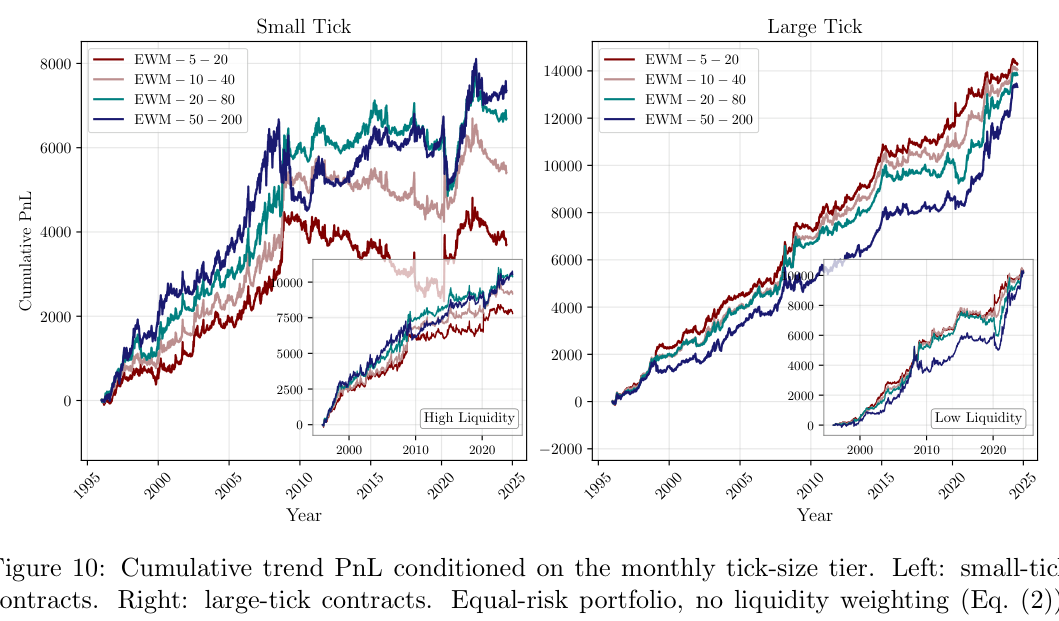
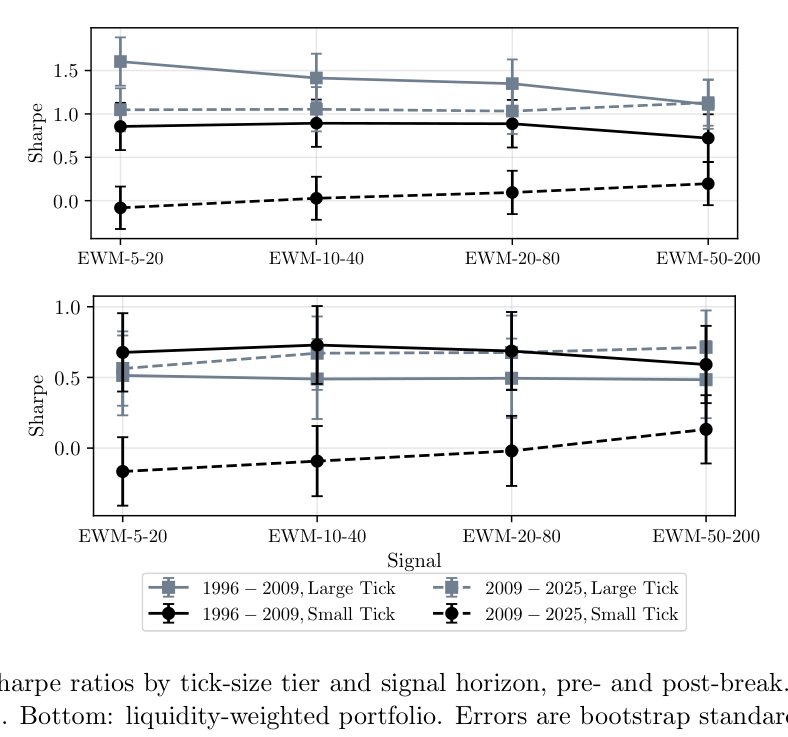
The interpretation: trend following at short horizons was partly a self-fulfilling impact loop: predictable directional flow pushed prices, which attracted more flow. Post-crisis HFT market makers detect predictable flow and pull liquidity in front of it, so the flow no longer moves price the same way. The feedback loop that fed fast trend is being arbitraged away at the microstructure layer. As the Top Traders Unplugged discussion of the paper put it: faster no longer means better.
Fast trend didn't fade — it was structurally out-traded by a faster player. That is a one-way door.
Why this debate is live right now
The paper landed on a raw nerve. The SG Trend Index posted -18.6% for the twelve months to May 2025, the worst rolling year in the index's 25+ year history, a roughly 20% drawdown from May 2024. Then 2026 flipped: trend funds are up roughly +8.4% year-to-date as of mid-July on gold, bonds and grains. So the industry is arguing about which story to believe: “structurally broken” or “normal drawdown, regime returning.” The CFM answer is both: slow trend survives (and Aspect Capital's June 2026 regime paper argues it should play a bigger portfolio role as stock-bond diversification decays), while fast trend is structurally gone in futures. The nuance is the whole answer.
The crypto exception
Here is what makes this a crypto desk's problem. The mechanism that killed fast trend is specific: mature HFT market making on small-tick, sparse order books. Crypto microstructure is younger: fragmented across venues, retail-heavy flow, funding-rate distortions, and market making that is competitive but not yet the monoculture that CME-style books have. And the evidence says trend in crypto still pays:
- Zarattini, Pagani & Barbon (SSRN, 2025): a Donchian-ensemble trend strategy with volatility sizing on a survivorship-bias-free crypto universe since 2015 delivers strong risk-adjusted returns and alpha over bitcoin, net of costs.
- Man AHL (“In Crypto We Trend”): volatility-scaled trend works in crypto in the largest CTA firm's own testing.
- Grayscale Research (2023): simple momentum overlays on BTC cut volatility and drawdowns while keeping most of the upside.
- Academic work through 2025-26 keeps finding time-series momentum in BTC/ETH “economically meaningful”: crypto today behaves like early-20th-century commodities, the golden age of trend.
One honest caveat: there is no SG-Trend-style index for crypto CTAs, so live fund evidence is thinner than backtests: treat the crypto claim as strong research consensus, not audited track records.
The TT desk thoughts
The CFM paper is the rare quant result with a falsifiable mechanism, and the mechanism is the alpha map. Fast trend dies where HFT market making matures on thin-tick books, which means the edge doesn't disappear, it migrates to markets where that condition fails. Crypto is the largest such market on earth. Perp books are deep but maker competition is still fragmented across venues; retail flow is real; and the impact-feedback loop that fed 1990s futures trend visibly still operates in every altcoin cycle. That is why Donchian channels that stopped working on the S&P in 2009 still print in crypto in 2025 backtests.
The desk read: run trend slow in traditional assets, run it faster in crypto, and treat crypto's microstructure maturation as the clock. The expiry date on crypto trend is the day its market making consolidates into a CME-style HFT monoculture: watch tick-size economics on major perps, maker concentration, and whether predictable flow still moves price. When crypto microstructure starts to look like the futures microstructure of 2010, the CFM result says fast crypto trend dies the same death. Until then, the anomaly the futures market lost fifteen years ago is still live in this one, and it is one of the few crypto edges with a peer-reviewed-grade explanation for why it should exist at all.
Keep reading
How perp DEXs work — crypto market structure · Crypto Capital Flows Analysis · All alpha