+First time on the top traders desk?
The desk runs its own numbers and publishes its calls next to the account that trades them. The short route:
 by
by Robinhood Chain, week one: the broker that's eating crypto's rails
Days after mainnet, Robinhood's own L2 flipped Hyperliquid in 24-hour DEX volume, crossed $1B cumulative and, per live Dune data, pulled ~500k addresses and 25M+ transactions onto the chain. The headline isn't the numbers. It's who put them up: a regulated broker, not a crypto-native, absorbing the entire on-chain stack.
- Robinhood Chain (an Ethereum L2 on the Arbitrum stack) went live July 1, 2026, and within its first week flipped Hyperliquid on 24-hour DEX volume with a $560M ATH and crossed $1B cumulative DEX volume, Uniswap alone topping $1B.
- Live Dune data showed ~497k cumulative addresses (267k active, 120k+ brand-new on July 10), 25.2M cumulative transactions with an 8.15M daily peak, $412k cumulative chain fees, 121 peak TPS and ~$250M protocol TVL.
- The structural point: this was a regulated broker, not a crypto-native, absorbing the full on-chain stack (exchange to wallet to chain to RWA tokenization), distributing tokenized stocks (NVDA, GOOG, AAPL) across 120+ countries.
- One honest caveat: the failed-transaction rate spiked to ~30% on the peak day, the signature of bot and farming traffic riding the incentive wave.
- The TT desk call: don't trade the launch-week volume (it will mean-revert), trade the structure: the durable variable is distribution, the one thing a regulated broker with millions of funded accounts doesn't have to bootstrap.
- Watch three things: whether daily transactions hold near their 8M peak or fall to the ~1M pre-surge baseline, whether tokenized-stock collateral actually gets used in DeFi, and the builders capturing fees (Uniswap, Lighter/$LIT, 1inch, Arcus).
The scoreboard
Robinhood Chain is an Ethereum Layer 2 on the Arbitrum stack, built for tokenized stocks and real-world assets with 24/7 settlement. Mainnet went live on July 1, 2026; Uniswap, Lighter, 1inch and Arcus were on it from day one. Here's where the first week landed:
cumulative transactions on the chain
Dune · Jul 10transactions on Jul 10 alone, a daily all-time high
Dune · Jul 10cumulative addresses; 267k active on Jul 10, 120k+ brand-new that day
Dune · Jul 10cumulative chain fees, ~$345k of it in the last 48h
Dune · Jul 10peak TPS (17.2 Mgas/s): throughput, not a testnet claim
Dune · Jul 1024h DEX volume: the ATH that flipped Hyperliquid
Coin Bureaucumulative DEX volume week one; Uniswap alone crossed $1B
Kerbrat · Uniswapprotocol TVL across the ecosystem
KerbratChain metrics pulled live from Entropy Advisors' Robinhood Chain dashboard on Dune ↗ (as of Jul 10, 2026). DEX volume and TVL are ecosystem figures from the sources above.
The surge, in the on-chain data
The Dune series tells the story the tweets only hint at. For the first week after mainnet, the chain ticked along near ~1M transactions a day. Then it broke open: 1.3M → 6.9M → 7.6M → 8.2M transactions on Jul 7-10, active addresses jumping from ~33k to 267k, and 120k+ first-time addresses in a single day. Daily fees went from ~$4k to $285k in the same stretch. That's not linear growth: that's the moment a brokerage's user base arrived on-chain at once.
Flipping Hyperliquid was the moment
Volume alone is noisy: incentive programs and wash-prone launch weeks inflate it everywhere. But Robinhood didn't beat a small L2 on a vanity metric; it beat Hyperliquid, the benchmark for on-chain trading throughput, on its home turf of DEX volume. And it did so while onboarding 120k+ first-time addresses in a day: the distribution advantage of a listed brokerage with tens of millions of funded accounts showing up on-chain at once. One honest caveat the Dune data surfaces: the failed-transaction rate spiked to ~30% on the peak day, the signature of bot and farming traffic riding the incentive wave. Some of this volume is real demand; some is mercenary. Both are visible in the same chart.
Robinhood Chain has collected $120K in chain fees in the last 48 hours. MegaETH did $3,000 in the same span.@stacy_muur
The real story: a regulated broker absorbing crypto's rails
Strip the launch-week fireworks and the structural point is the one that matters. This isn't a crypto company bolting on TradFi. It's the reverse: a regulated broker absorbing crypto's rails: exchange → wallet → blockchain → RWA tokenization, integrated top to bottom. Tokenized stocks (NVDA, GOOG, AAPL) that trade 24/7, post as collateral, and route into on-chain lending, distributed through Robinhood Wallet across 120+ countries. The chain is the settlement layer for a brokerage that already owns the customer.
We pulled four theses out of The Chopping Block's discussion with Vladimir Novakovski (@vnovakovski) that frame why this is a market-structure event, not a product launch:
Vertical integration, not a pivot
Exchange → wallet → chain → RWA tokenization, owned end to end. The deal isn't Robinhood chasing crypto; it's a regulated broker internalizing the rails crypto spent a decade building.
Wrong debate, reframed
The question isn't "are tokens securities?" It's what economic rights a token can encode that equity can't: fee sharing, governance, access, composability. A regulated entity entering forces that conversation from the compliant side.
Governance broken by design
Token-weighted voting + no legal wrapper + on-chain treasury = capture is structural, not a people problem. The contrast with a chain that has a real legal entity behind it is the entire point.
Crypto is now unavoidable
The largest financial disclosure in presidential history put crypto holdings at a scale never seen. When policy-makers' own portfolios are crypto-heavy, regulation stops being "if" and becomes "how."
Why this is an investment question, not a headline
The bear case writes itself: week-one volume is subsidized, first-time users are airdrop farmers, and a broker's captive flow isn't the same as durable on-chain demand. All fair. But the durable variable is distribution, and that's the one thing a regulated broker doesn't have to bootstrap. Hyperliquid earned its users; Robinhood already had them and moved them on-chain. If even a fraction of a funded, KYC'd, equities-trading base stays to trade tokenized stocks as collateral, the flywheel (fees, TVL, builders, more fees) compounds off a base no crypto-native can match.
This also sharpens a debate we've written on before. Robinhood pulls the token-vs-equity question onto regulated ground: here the equity is public and the on-chain assets are tokenized securities, not a governance token standing in for a promise. That's a cleaner structure than most of crypto, and a harder one to argue is "just exit liquidity."
The TT desk thoughts
Don't trade the launch-week volume; it will mean-revert. Trade the structure. The winners of the RWA cycle are the platforms that already own regulated distribution, and Robinhood just proved a broker can stand up an L2 that out-trades the best crypto-native venue in a week. Watch three things on the Dune dashboard from here: (1) whether daily transactions hold near their 8M peak or fall back toward the ~1M pre-surge baseline once incentives normalize, and whether the ~30% fail rate cools; (2) whether tokenized-stock collateral actually gets used in DeFi, or stays a demo; (3) the builders capturing fees on someone else's regulated distribution: Uniswap, Lighter ($LIT), 1inch, Arcus. If the rails are Robinhood's and the flow is real, the apps deployed on top are the leveraged way to own it.
Watch: The Chopping Block on the Robinhood deal
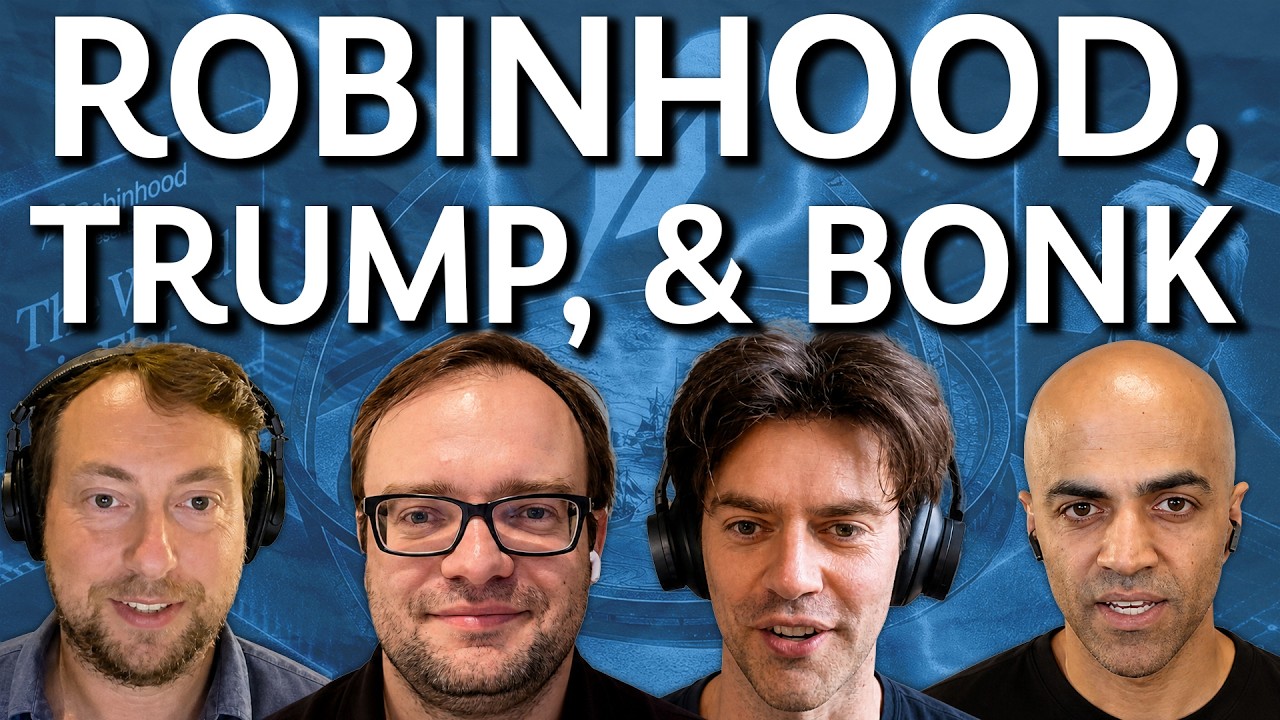
Vladimir Novakovski (@vnovakovski) on the Robinhood deal, token vs equity, and how not to run a DAO.
▸ Episode timestamps & the token-vs-equity thread
00:00 Intro
03:40 Tokens vs equity
06:12 Fiduciary obligations
08:00 What happens when buyback capital runs out
12:42 Why launch a token
19:18 Comparing VVV to BNB
25:28 Lighter's Robinhood Chain deal
37:02 BonkDAO governance exploit & the $20M vote
47:09 Trump's $2.4B disclosure
Why it connects to Robinhood Chain
The through-line: crypto is being absorbed into the existing regulated system rather than replacing it. Robinhood entering forces the token-vs-equity debate from the compliant side; the DAO autopsy shows what happens without a legal wrapper; and the record political disclosure shows crypto is now unavoidable to policy. Four threads, one thesis: the question is no longer whether crypto merges with TradFi, but who writes the rules when it does.
Source: @_ChoppingBlock · full episode on YouTube.
Keep reading
Token vs equity: is the token just exit liquidity? · What is RWA tokenization? · How crypto and TradFi converge · All alpha